

By Jeana L. Goosmann, CEO, Founding & Practicing Attorney
A holding company structure can be one of the most effective ways to protect business assets, separate risk, and create a stronger foundation for growth. But simply forming multiple entities is not enough. Without proper corporate maintenance, courts may disregard the separation between companies, exposing assets business owners believed were protected.
A business owner structured multiple entities with a holding company, separated real estate from operations, and organized ownership in a way that looked correct on paper.
In practice, it was a different story.
One bank account was used for multiple entities. Contracts were signed inconsistently. Expenses were paid wherever cash was available. There were no formal intercompany agreements. When litigation arose, the opposing side argued the companies were not truly separate, and the court agreed.
The liability did not stop with the operating company. It reached assets the owner believed were protected.
That’s the nightmare scenario, and in many cases, it’s avoidable.
The problem usually isn’t the holding company structure itself. It’s the gap between the legal structure on paper and the way the business is actually operates. A holding company can provide meaningful asset protection and organizational benefits, but only when each entity is treated as a separate business in both legal documents and day-to-day operations.
Understanding how holding companies work, and how to properly maintain them, is just as important as creating them in the first place.
What Is a Holding Company?
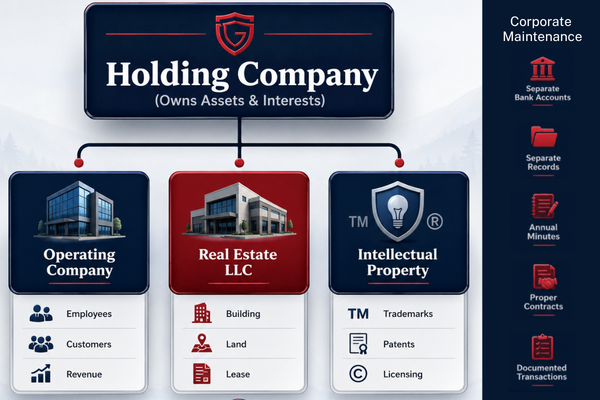
A holding company is a legal entity created to own other businesses or valuable assets rather than conduct day-to-day operations itself. It may own operating companies, real estate, intellectual property, investment accounts, or other business interests. The operating company runs the business, while the holding company owns the assets or ownership interests.
When thoughtfully designed and properly maintained, this structure can help business owners reduce risk, organize ownership, support succession planning, and preserve long-term enterprise value.
Why Business Owners Use Holding Companies
For many business owners, a holding company structure makes good business sense because it separates ownership from operations.
A holding company can help:
- Separate business risk from valuable assets
- Keep real estate apart from operating liabilities
- Hold intellectual property outside the day-to-day operating company
- Create cleaner ownership and management structures
- Support estate planning and business succession
- Prepare a business for a future sale or transition
- Protect family wealth and enterprise value
We are strong proponents of holding company structures when they are thoughtfully designed and properly maintained. They can give business owners greater flexibility, stronger protection, and more confidence as their businesses grow
Why Corporate Maintenance Matters
Forming the entities is only the beginning.
Corporate maintenance is what keeps the structure intact.
Corporate maintenance means consistently treating each entity as its own independent business. It includes maintaining separate records, following operating agreements, documenting important decisions, and ensuring each company operates within its intended role.
It also means:
- Maintaining separate bank accounts
- Keeping separate accounting records
- Completing required Secretary of State filings
- Maintaining annual corporate minutes
- Keeping the corporate book current
- Documenting intercompany transactions
- Following governance requirements
- Maintaining proper contracts and ownership records
Without this discipline, the legal structure begins to blur. When that happens, the legal protections can blur with it.
Courts often look beyond organizational charts and formation documents. If a dispute arises, they may ask practical questions:
- Are the bank accounts truly separate?
- Are contracts signed by the correct entity?
- Are intercompany loans documented?
- Are employees properly allocated?
- Are expenses paid by the correct company?
- Does each company maintain its own records?
- Is each entity observing its governance requirements?
Corporate maintenance is not busywork. It preserves the integrity of the structure you worked to create.
Why South Dakota LLCs Deserve a Close Look
For many business owners, a South Dakota LLC can be an especially attractive entity within a holding company structure.
South Dakota offers strong LLC laws and meaningful asset protection features. One of its most significant advantages is charging order protection.
In simple terms, if a creditor obtains a judgment against an LLC owner personally, the creditor’s remedy may be limited to distributions that would otherwise be made to that owner. The creditor does not automatically gain management rights, seize company assets, force distributions, or step into ownership.
This is often referred to as outside-in protection. It protects the business from an owner’s personal creditors, which is different from the more familiar inside-out protection that shields owners from business liabilities.
For families, entrepreneurs, investors, and business owners building long-term enterprise value, that distinction can be extremely important.
South Dakota LLCs often work especially well as part of broader strategies involving trusts, estate planning, family business succession, and asset protection planning.
The Risk: Piercing the Corporate Veil
One of the greatest risks to any holding company structure is failing to operate the entities as separate businesses.
Courts generally respect properly formed and properly maintained entities. Simply owning multiple companies does not create a problem.
The risk arises when the legal structure says one thing, but daily operations say something else.
A court may take a closer look when:
- Multiple companies use the same bank account
- One company pays another company’s bills without documentation
- Contracts are signed by the wrong entity
- Employees work across entities without clear allocation
- Assets move between companies without written agreements
- Companies fail to maintain separate records
- Governance requirements are ignored
- Owners treat company assets as personal assets
- A company is inadequately capitalized
- The structure appears designed to avoid known creditors
In those situations, a plaintiff may argue the entities function as one enterprise and should be treated that way for liability purposes.
The Holding Company Isn’t the Problem
The problem is rarely the holding company. The problem is a lack of discipline.
A well-designed holding company structure can protect assets, organize ownership, and support long-term planning.
A poorly maintained structure can create a false sense of security.
The legal documents matter. Daily business practices matter just as much.
Business owners should think of entity protection as an ongoing business practice, not a one-time filing.
How to Strengthen a Holding Company Structure
The strongest structures combine thoughtful legal planning with consistent operational discipline.
Ask whether each entity has:
- Its own bank account
- Its own accounting records
- Clear ownership documentation
- Signed operating agreements
- Proper contracts with third parties
- Written intercompany agreements
- Documented loans or capital contributions
- Proper employee and expense allocations
- Insurance appropriate for its role
- Regular legal, tax, and financial reviews
If one company owns real estate while another operates the business, the lease should be documented.
If one company owns intellectual property and another uses it, the licensing arrangement should be documented.
If employees support multiple entities, payroll and expense allocations should reflect reality.
The more valuable the business or asset, the more important this discipline becomes.
When Should You Review Your Structure?
Don’t wait until there’s a lawsuit, creditor issue, ownership dispute, divorce, sale, or succession event.
A review is especially worthwhile when:
- You acquire or sell a business
- You purchase real estate
- You add a partner or investor
- You move assets between entities
- You establish a family trust or estate plan
- You launch a new line of business
- You refinance or change banking relationships
- You begin succession planning
- You’re concerned about creditor exposure
- Your business has significantly grown since it was formed
Many businesses begin with a single LLC and gradually become more complex.
That’s normal.
Your legal structure should evolve as your business evolves.
Questions Business Owners Ask About Holding Companies
What is a holding company?
A holding company is a legal entity that owns other businesses or valuable assets instead of conducting day-to-day business operations itself.
Does a holding company automatically protect my assets?
No. The structure only provides protection when each entity is properly maintained and operated independently.
What is corporate maintenance?
Corporate maintenance includes maintaining separate records, bank accounts, annual minutes, governance documents, required filings, and properly documenting transactions between related companies.
What does “piercing the corporate veil” mean?
In certain circumstances, a court may disregard the legal separation between companies or between a company and its owners when business formalities have not been respected.
Why do some business owners use South Dakota LLCs?
South Dakota LLCs offer strong asset protection features, including charging order protection, making them an attractive option within many holding company structures.
The Bottom Line
Holding company structures can be an effective way to protect assets, organize risk, and prepare for future growth. A South Dakota LLC may provide additional protection when paired with strong governance and a broader business, estate, or asset protection strategy.
These structures work.
But only when they are respected.
Separate entities should operate like separate entities. Bank accounts, contracts, employees, assets, records, and governance should all align with the legal structure. Corporate maintenance, including annual minutes, corporate books, required filings, and ongoing governance, is what keeps those protections in place.
If your business has grown beyond a single LLC, you’re acquiring real estate, bringing on partners, preparing for succession, or simply haven’t reviewed your entity structure in several years, now is a good time to revisit whether your legal structure still supports your goals.
At Goosmann Law Firm, we help business owners, executives, families, and companies create clarity around complex ownership structures. Whether you’re forming a new entity, reorganizing an existing business, or planning for the future, the right structure, properly maintained, can provide greater confidence to pursue what’s worth it.
Disclaimer: This article is for general informational purposes only and is not legal or tax advice. Every business structure depends on its unique facts, applicable law, tax considerations, ownership goals, and creditor risks. Consult qualified legal and tax advisors before forming, reorganizing, or relying on any business entity structure.